
Your Pipeline Should Follow Your Client’s Decision Process, Not Your Sales Process
A Step-by-Step Guide to Buyer Journey Mapping for B2B founders and sales leaders who are tired of forecasts that miss.
Ask most B2B sales leaders to walk you through their pipeline stages, and you’ll hear something like this: Discovery, Proposal, Negotiation, Closed. Sometimes there’s a “Qualification” stage tacked on at the front and a “Contract Review” stage added near the end.
These stages make perfect internal sense. They map to activities your team controls. They tell your salespeople what to do next. And in many cases, they were borrowed from a default CRM template and never really questioned.
But here the problem: those stages describe what your team is doing. They say almost nothing about what your client is doing. And because your forecast is built on top of those stages, you are essentially predicting revenue based on your own actions rather on where your client actually is in their decision process. You don’t hold the purse strings. They do.
That gap between your internal process and your client’s actual decision journey is the single most common structural reason that sales forecasts in professional services firms miss the mark.
Forecasts built on internal activity stages reflect what your team is doing. Forecasts built on buyer journey stages reflect what your client is deciding. Only one of those predicts revenue.
This article walks you through a practical, step-by-step process for mapping your client’s buying journey and rebuilding your pipeline around it. While the examples here are drawn from IT consulting and managed services, the methodology applies equally to other professional services firms where decisions are complex, multi-stakeholder, and high-value.
Why Your Current Pipeline is Probably Wrong
Before getting into the how, it’s worth understanding why this problem is so pervasive and why it matters more than most sales leader realize.
The data on forecast accuracy across B2B sales organizations is not encouraging. According to a 2024 report from Xactly, only 20 percent of sales organizations met their annual forecast within five percent of projections, an more than half of revenue leaders missed a forecast at least twice in the prior year.
A separate analysis from SiriusDecisions found that 79 percent of sales organizations miss their forecast by more than 10 percent. And research from CSO Insights puts the average forecast accuracy at 46% among companies without a formalized forecasting process…meaning they are essentially wrong more than half the time.
These are not outlier numbers. They describe the norm across professional services, technology, and B2B sales broadly. And the root cause, in most cases, is not the tools or the people. It is the structure of the pipeline itself.
When pipeline stages are built around seller activity rather than buyer behavior, two things happen consistently.
Deals get moved forward prematurely, because the rep completed a task (sent a proposal, scheduled a call) rather than because the buyer made a meaningful decision.
Close dates get set based on internal timelines and quota pressure rather than on anything the buyer has actually indicated.
The result is a pipeline that looks healthy on paper but consistently fails to convert at the rates you’d expect. The problem isn’t that your team isn’t working hard enough. It’s that you’re measuring the wrong things.
The Buyer Behavior Reality Check
Recent research underscores just how much of the decision process happens before (and independently of) your sales team:
According to Gartner’s 2024 research, B2B buyers spend only 17% of their total buying time in direct contact with potential vendors, meaning roughly 80% of the journey is self-directed.
Source: Gartner, 2024 B2B Buyer Behavior Research
6sense’s 2024 Buyer Experience Report, which surveyed 2,509 recent B2B buyers. found that nearly 70 percent of the purchasing process is complete before buyers engage with a sales rep, and that 81 percent of first contacts are initiated by the buyer, not the seller.
Source: 6sense, 2024 Buyer Experience Report
The same report found that 94 percent of buying groups rank their preferred vendors in order before initiating any sales contact, and the vendor ranked first wins approximately 80 percent of the time.
Source: 6sense, 2025 Buyer Experience Report
The implication is significant: by the time a prospect enters your pipeline, they already have context, preferences, and inn many cases a working hypothesis about who they want to work with. A pipeline that starts at “Discovery Call” and ends at “Close” misses the entire first half of the journey.
What Buyer Journey Mapping Actually Means
Buyer journey mapping is the process of documenting the specific sequence of steps, decisions, and internal milestones your client goes through from the moment they first recognize a problem to the moment they sign a contract.
It is not a marketing exercise. It is not a theoretical framework. It is a practical tool for understanding how your best clients actually made their buying decision, so that you can build a pipeline that reflects that reality rather than your internal sales workflow.
For a B2B services firm, a typical client buying journey might look like this:
A specific event triggers internal recognition that a problem exists and outside expertise is needed.
Internal stakeholders begin discussing the problem informally. Leadership acknowledges it is beyond internal capacity to resolve quickly.
Research begins, usually without involving any vendors. Options are identified, compared, and shortlisted.
Initial conversations happen with a small number of firms. These are exploratory, not transactional. The buyer is still calibrating and testing cultural fit.
A formal evaluation process begins. This may involve a proposal, an assessment, a presentation, or a scoped work sample depending on the context.
Internal consensus is built. A recommendation is made to the budget authority. This step is often invisible to the vendor.
A decision is made. Commercial terms are negotiated. The contract is signed.
Notice how different this is from the typical sell-centric pipeline: Discovery, Proposal, Negotiation, Close. Those stages map to your actions. The steps above map to your client’s decisions. The first helps your team know what to do next. The second helps you understand where the client actually is, and how likely they are to move forward.
Step-by-Step: How to Map your Client’s Buying Journey
This process works best when you have closed at least five to ten deals to draw from. If you are earlier in your firm’s history, you can supplement your own experience with interviews from prospects who ultimately did not buy. They often provide the most honest picture of how decisions actually get made.
Step 1: Start with Your Best Clients
Pull a list of the last eight to twelve deals you closed that represent your ideal engagement profile (the right size, the right industry, the right type of project). Exclude the outliers: the deal that moved in two weeks because of an emergency, the one that dragged for eighteen months due to internal politics.
For each deal, you want to reconstruct the full timeline, starting before your first conversation with them. You’re looking for:
What triggered their recognition that they had a problem?
Who was involved in the internal conversation before they reached out?
How did they find you, and what did they do before contact you?
What was happening internally at each stage of your conversations?
Who made the final decision, and what did they need to feel confident?
What nearly caused the deal to fall apart, and how was it resolved?
You will not have perfect information here. The goal is pattern recognition, not forensic account. You are looking for the consistent sequence of events that characterizes how your typical client moves from problem awareness to signed contract.
Step 2: Interview the Buyers
If you have strong enough relationships with four or five recent clients, ask for a thirty-minute retro. Frame it as research to help you serve your clients better. Most clients who value the relationship will say yes.
Your goal is to understand their internal experience, not to validate your sales process. Ask questions like:
What was the specific event or moment that made this problem feel urgent enough to act on?
Who else was involved in the conversation internally before your reached out to us?
What were you looking for in those first conversations with vendors?
Was there a moment when you were close to not moving forward? What resolved it?
What made you confident enough to recommend us internally?
These conversations will surface things that your CRM data never captured. Decisions that almost fell apart for reasons that you weren’t even aware of. Internal champions who were critical to the outcome. Steps in the process that happened entirely without your involvement.
Step 3: Identify the Decision Milestones
Once you have reviewed your deal history and conducted buyer interviews, look for recurring milestones that appear across most of your closed deals. You are not looking for every step. You’re looking for the decision moments that consistently determine whether a deal advances or stalls.
While the specific milestones will vary by businesses, these six tend to appear consistently across B2B professional services.
Problem Acknowledged Internally - Leadership has named the problem and agreed it needs outside expertise.
Vendor Research Underway - The buy is actively evaluating options, with or without your knowledge.
Initial Engagement - The buyer has initiated contact and is assessing fit, scope and capability.
Internal Champion Identified - Someone inside the firm is actively advocating for you to the decision-maker
Budget and Authority Confirmed - The person with final approval is engaged and aware of the investment required.
Decision Made, Commercial Terms Agreed - The client has chosen you and both parties are working toward contract execution.
Your version of these milestones may look different depending on your specific client profile, deal size, and complexity. The point is to define them based on observed buyer behavior, not assumed seller workflow.
Step 4: Define Observable Evidence for Each Milestone
This is the step that most firms skip, and it is the one that matters most for forecast accuracy.
For each milestone in your buyer journey map, define what observable evidence confirms that the buyer has actually reached it. Not what your rep believes or hopes. Not what the buyer said during a call. Specific, verifiable indicators that can be confirmed and logged in your CRM.
For example:
Internal Champion Identified
Weak evidence: “The VP seemed enthusiastic on the call”
Strong evidence: “The VP proactively introduced us to the COO and offered to set up a working session with their internal IT team.”
Budget and Authority Confirmed
Weak evidence: “They said budget shouldn’t be a problem.”
Strong evidence: “The CEO joined the pricing conversation, confirmed the budget range, and asked about contract start dates.”
Decision Made, Commercial Terms Agreed
Weak evidence: “They said they’re going to move forward with us.”
Strong evidence: “We received written confirmation of their intent, agreed on scope and investment, and are in contract review.”
This distinction matters because forecast accuracy depends on pipeline stages reflecting reality. Research from DealHub notes that close dates and stage advancement should be grounded in buyer behavior and verified next steps, not internal timelines or optimism.
When stage advancement requires observable buyer evidence rather than seller activity, your pipeline becomes an accurate reflection of where deals actually stand. That is the foundation of a forecast you can defend.
Step 5: Map Your Pipeline Stages to the Buyer Journey
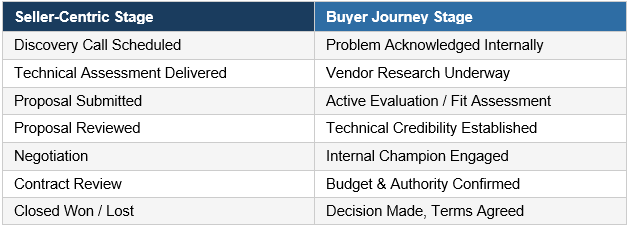
Now you are ready to rebuild your pipeline. Take each milestone from your buyer journey map and create a corresponding pipeline stage. The stage name should describe the buyer’s state, not your action.
A few important notes on this translation:
You do not need to eliminate seller activities from your process. Your team still needs to know what to do at each stage. But those activities should be listed as tactics within each stage, not the stage definition itself.
Some buyer journey stages may happen before your team is even involved. That is fine, and expected. Acknowledging this helps you understand where you can create earlier visibility rather than waiting to be contacted.
Not every deal will move through every stage in sequence. Complex or multi-stakeholder deals may revisit earlier stages. Build this flexibility into how you use the framework.
Compare the two approaches side by side:
Step 6: Assign Close Probabilities Based on Historical Data
Once your new pipeline stages are in place, assign close probabilities to each stage based on your actual historical win rates, not generic industry benchmarks and not your team’s gut feel.
Go back through your closed deals from the past twelve to eighteen months. For each deal, not what stage it was in at the point when it either closed or fell apart. Calculate the conversion rate from each stage to a closed deal. Those conversion rates become your stage probabilities.
If you do not have enough historical data to do this precisely, use conservative estimates to start and refine them over two to three quarters as you accumulate data. Research from DemandZen and other pipeline management sources consistently shows that stage probabilities should reflect historical outcomes rather than aspirational assumptions.
The principle is straightforward: if only 30 percent of deals that reach your “Internal Champion Engaged” stage ultimately close, then that stage should carry a 30 percent probability in your forecast, not the 60 percent it might carry in your current system because a proposal has been submitted.
Step 7: Define Stage Entry and Exit Criteria
For your pipeline to remain accurate over time, every stage needs documented entry criteria - the specific, observable buyer actions or statements that must be confirmed before a deal is moved to that stage.
This is where most sales teams lose discipline. Without clear criteria, reps move deals based on their own optimism rather than on verified buyer behavior. Research from the forecasting field is consistent on this point: optimism bias leads reps to over-forecast by 20 to 40 percent on average, and the root cause is almost always insufficient stage discipline.
Define entry criteria for each stage in plan language. Write them down. Put them in your CRM as prompts. and review them in your pipeline calls. The question should not be “where does the rep think the deal is?” It should be, “What did the buyer do that confirms we belong in this stage?”
Step 8: Build it Into Your Pipeline Review Process
A redesigned pipeline is only valuable if your team uses it consistently. That requires integrating it into your regular pipeline review cadence.
Specifically:
In every pipeline review, ask about buyer evidence, not seller activity. “What did the client do this week?” is a more useful question than “what did you send them?”
Challenge stage placements that lack verifiable buyer evidence. If a rep cannot articulate a specific buyer action that supports the current stage, the deal should be moved back.
Track close date slippage by stage. If deals in a particular stage consistently slip, your conversion rates and timeline assumptions for that stage need to be updated.
Review your stage probabilities quarterly and update them based on actual outcomes. Your pipeline is a model, and models improve over time with better data.
What This Changes in Practice
When you rebuild your pipeline around the client’s buyer journey rather than your internal sales process, several things shift.
Your forecast becomes more accurate
Because stage advancement now requires verified buyer behavior rather than seller activity, the deals in your pipeline more accurately represent where clients actually are in their decision process. That means your close date projections become more reliable and your pipeline coverage ratios become more meaningful.
You identify at-risk deals earlier
When your pipeline stages map to buyer decisions, stalled deals become visible faster. If a deal has been in “Internal Champion Engaged” for four weeks with no new buyer activity, that is a signal worth investigating…not a sign you should send another follow-up email. You now have the context to ask a more informed question: what is happening on their end that has slowed this down?
Your conversations with buyers become more valuable
When you understand where your client is in their decision process, you can meet them there. A client who is still in the “Vendor Research Underway” stage needs different information than one who is building internal consensus for a budget conversation. Aligning your outreach and content to their stage rather than your sales calendar produces more relevant, better-time communication.
Leadership gets a forecast they can trust
This is often the most immediate practical benefit for a head of sales. When your pipeline reflects buyer behavior rather than seller activity, and when your probabilities are grounded in historical conversion rates rather than guy feel, your weekly or monthly forecast conversation changes.
A forecast built on buyer-journey pipeline stages is not just more accurate. It is more credible. That credibility compounds: better decisions get made, trust with leadership increases, and the entire organization plans more effectively.
Getting Started: Where to Begin This Week
If you want to begin this process without waiting for a full project, start here:
Pull five to eight of your recent closed deals. For each one, write a brief narrative of how the client made their decision, not how you sold to them. What triggered the process? Who was involved? What nearly stopped it?
Identify the three to five moments that appear in nearly every deal. These are your recurring buyer decision milestones. They will form the backbone of your new pipeline stages.
Write down the observable evidence that would confirm a client has reached each milestone. Be specific. “Seems interested” is not evidence. “Scheduled a working session with their internal team” is.
Map your existing pipeline against the new stages. Look at every open deal and ask: based on buyer evidence, where does this deal actually belong? You will likely find that several deals need to move back a stage or two.
Run one pipeline review using the new framework. Ask your team about buyer evidence instead of seller activity. Note where the conversation changes.
None of this requires new technology or a significant time investment to start. It requires a willingness to look at your pipeline differently — through your client’s eyes rather than your own.
Not Sure Where to Start?
Rebuilding a pipeline around the buyer’s journey is straightforward in principle, but doing it accurately in practice requires an honest assessment of your current pipeline, a clear picture of how your clients actually make decisions, and the discipline to enforce new stage criteria with a team that is used to the old way.
That is often easier with an outside perspective. Someone who can assess your current pipeline objectively, facilitate the buyer journey mapping process, and help your team adopt the new framework without losing momentum on active deals.
If you have questions about how this works in practice or you want to think through how it applies to your specific situation, reach out directly.
Email: josh@revmotiv.com
Website: revmotiv.com
No pitch. No pressure. Just a straightforward conversation about where your pipeline stands and what it would take to make it more predictable.
Sources
6sense. (2024). 2024 B2B Buyer Experience Report. https://6sense.com/newsroom/6sense-launches-2024-buyer-experience-report-unveiling-global-b2b-buyer-trends/
6sense. (2025). 2025 B2B Buyer Experience Report. https://6sense.com/science-of-b2b/buyer-experience-report-2025/
DealHub. (2025). Sales Forecast Accuracy Guide. https://dealhub.io/glossary/sales-forecast-accuracy/
DemandZen. (December 2025). Define Pipeline Stages for Better Forecasting. https://demandzen.com/define-sales-pipeline-stages-for-forecasting/
5P Sales. (February 2026). Sales Forecast Accuracy: Improve B2B Forecasting. https://blog.the5psales.com/sales-forecast-accuracy/
Forecastio. (2025). Sales Pipeline: Key Strategies & Metrics to Boost Revenue. https://forecastio.ai/blog/sales-pipeline
Gartner. (2024). B2B Buying Behavior Research. Referenced via Brixon Group: https://brixongroup.com/en/the-modern-b2b-buying-journey
Harvard Business Review. (2025). Pipeline Management and Revenue Growth. Referenced via Forecastio.
Xactly. (2024). Sales Planning Report. Referenced via Outreach: https://www.outreach.io/resources/blog/revenue-forecasting-101
CSO Insights / SiriusDecisions. Sales Forecasting Accuracy Benchmarks. Referenced via Forecastio and 5P Sales.
© 2026 RevMotiv. All rights reserved. | revmotiv.com